
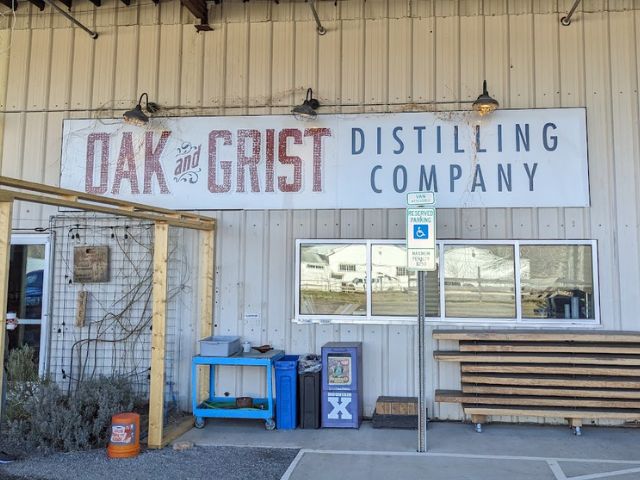
Oak And Grist Distilling Company
Drew (00:00):
It's just about time to head right down the road from my hometown of Asheville, North Carolina with a visit to Oak Andris Distilling. I'm telling you though, if you want an extra 22 minutes of interview time from this particular interview, you need to be a member of the speakeasy at patreon.com/whiskey. It's also the place that is the home of the medal rounds of Whiskey LO's fan favorite Craft Distillery Awards, which those nominations for Distillery of the Year will start this week. You can get your seven day free trial at patreon.com/whiskey lore. Welcome to Whiskey Lord's Whiskey Flights, your weekly home for discovering great craft distillery experiences around the globe. I'm your travel guide, drew Hanish, the bestselling author of experience in Kentucky Bourbon, experiencing Irish Whiskey, and the brand new book that busts 24 of Whiskey's biggest myths, whiskey lore, volume one. And today I am not too far from my home base of Greenville, South Carolina, and actually not too far from where I grew up in Asheville, North Carolina.
(01:13):
We're going to go just a little bit to the east and the town of Black Mountain. And joining me on this journey are my niece and nephew, Becca and Brian, who are the ones that actually turned me onto Oak and Gris Distillery in Black Mountain. It was Christmas about a year and a half ago when they brought out this single malt, and I said, well, I do like single malts, and whenever there's a really great American single malt, I always like to promote it and oak and grist. I got to tell you, it was excellent. And so I've wanted to have Will and Charlie on the show for quite some time. Of course, we had this little weather event that happened in Western North Carolina that put everything on hold for a while. When I saw that Will and Charlie were handing out potable water to the community after Hurricane Helene, I knew it was probably good to hold off for a little bit, let those guys catch up on getting their work done, and then we would sit down and relax and have a good conversation.
(02:14):
So that is going to happen today. And for those of you who are not familiar with Black Mountain, North Carolina, it's really close to Asheville. Asheville for the longest time has been fighting with Grand Rapids and Portland for Beer City, USA. Wherever there's beer, it's usually an easy transition to go into doing a single mall because you're working with barley. Well. They're also doing a lot of barrel aging experiments and also some different techniques with blending. So we got a lot of stuff to talk about today, and I'm going to jump right into this conversation with Will Goldberg and Charlie Stanley. And we'll start off with William thought it'd be good to start out by learning a little bit about his background and how he got interested in making whiskey.
Will & Charlie (03:02):
So I've always been fascinated with making things from scratch. So cooking, baking, building stuff with my folks as a kid ended up going to college for sustainable agriculture. In doing that, I discovered a deeper passion for what I now understood to be value added agriculture as a internship required for my degree, I started working at a small batch cheesemaker here in Western North Carolina and did that for about a decade at a couple different places. As I was graduating from college, though, I sort of hatched this plan, or at least this dream of starting a distillery. I had very much learned through my education that while I was interested in farming, I didn't necessarily want to go straight into farming. I'd worked at a bunch of farms, understood it, and not that I struggle any less now doing a craft distillery, but the struggle that a farmer sees to sort of grow and sell crops as crops was something that I wasn't necessarily wanting to do right away.
(04:13):
It may still be something that I go into, but the value added side really interested me, and I began to see whiskey as a value added agricultural product. So when I graduated from college in 2010, I flew over to Scotland to stay with my mentor, Edwin Dodson, who is a retired master distiller over there and sort of did a crash course in whiskey making. He took me around to a whole bunch of Scottish single malt distilleries, Abel Hour, the distillery. He retired from Murray Glenn Morange. I mean, there was a handful more on that trip. Came back, sort of realized that at 21 maybe I was in a little bit over my head, didn't necessarily have the gumption to really get the distillery thing off the ground. So I kept going as a cheesemaker, but never really got it out of my head as something that I thought would be really fulfilling for me to do and really scratch that itch of a lot of different passions that I have. Fast forward, end of 2014, I called up Edwin and said, I haven't been able to get this out of my head. I think I'm going to do this, any interest in helping me get this thing off the ground. And he said yes. Right then and there.
(05:29):
Next day I was writing a business plan and starting to look at how we might finance something like this.
Drew (05:35):
It's kind of handy to have a 20 year distillery manager vet coming in to help you get started.
Will & Charlie (05:43):
Yeah, he started his career at, I believe it was 14 raking malt.
Drew (05:51):
Wow.
Will & Charlie (05:52):
He retired, I believe in 2006 after more than years in the industry as master distiller at Glen Murray. So it's sort of that old school passing of the torch of information versus if you go to Scotland now, like last time I went in 2019, all the master distillers were chemical engineers and biochemists and things like that. Whereas Edwin is a very smart man, but didn't necessarily have that formal of an education in distilling specifically. It was a practical education.
Drew (06:31):
So what happens when he gets, was single malt really in your mind when you got kicked up with this or?
Will & Charlie (06:38):
Yeah, absolutely. It was the thing that I wanted to make our Geneva was a product to sort of fill that void that was going to be there while our whiskey was aging.
Will & Charlie (06:50):
Yeah.
Will & Charlie (06:51):
We always get asked the question, when are you going to make a bourbon? And my answer is absolutely never. There's enough bourbon out there. We do not need oak and GR to be making a bourbon. And I also learned in the cheese side of things, the very important lesson of you can do a lot of things or even sometimes good,
(07:15):
But I really wanted to focus on doing a couple things really well. And so that's been my focus is not to be a craft distillery that makes every spirit under the sun, a vodka gin, a bourbon, a single malt, a rye whiskey, a handful of laurs and all that it is to right now, we essentially have two products. We have single malt whiskey, and of course we have them aged in different ways. And then we have our Geneva, and over the years we have some things that are in r and d in the back. But for me, it's a very slow moving process of expanding that line.
Drew (07:55):
Yeah. Charlie comes in on this and it's really interesting to note that you talk about terroir and this idea you come out of a wine background.
Will & Charlie (08:06):
That's correct.
Drew (08:07):
Yeah. So what was it that drew you to distilling from the wine world?
Will & Charlie (08:13):
A couple of different things. I had worked in many facets of the wine world, both in import and wholesale, had been a wine buyer for a shop. I got my start in my early twenties driving a delivery truck and knowing essentially nothing about wine. And it really opened up. As I started to learn more about it, I realized it was a combination of many things that I saw as disparate interests of mine, whether it was science or geography or geology or weather or food and history. All of these elements kind of were contained within a bottle of wine,
(08:47):
And I really fell in love with it. I got to the point where I was traveling a lot, driving insane amount in North Carolina. I did 62,000 miles of driving my last year as an account manager and really wanted something different. And the longer I'd been doing it, knew I was passionate about alcohol production, but wanted to be a producer myself rather than tell the stories of someone else's products to sell 'em. And I'm very thankful I had the evaluation background of learning how to taste analytically very well. It really laid a great foundation to coming into the whiskey world. But all of my family on both sides for generations are from Kentucky.
(09:29):
And so while my parents aren't big drinkers, I grew up with that culturally existing around it. And I kind of laugh that I'm in no way the first person in my family to make whiskey. I'm just the first one to ever pay taxes on it. But it really felt like home. And the wines that I was most interested in drinking were sustainably farmed wines, whether they were organic or biodynamic, they were thoughtful agricultural creations. And when I found Oak Andris and what they were doing that really spoke to me. I didn't particularly have an interest in working for a distillery or in non distilling producer that was buying sourced spirits. I wanted to be taking a raw product and creating something that I could then sit down and drink across the table with someone. And Oak Andris really represented the philosophical approach that I was interested in.
Drew (10:24):
And you kind of worked your way up through this?
Will & Charlie (10:26):
I did. I started out as a 34-year-old intern working for William four and a half years ago now. So a little bit of a humbling process to some degree, but I think very healthy in that way. And just the more that he put in front of me, the more I was curious about it and I said, I want to learn about this. I feel like I've learned a lot about this. What's next? Let's keep progressing. And that was the other thing that I will say specifically about Oak Andre that really drew me here, but a lot of loyalty to stay is that if you want to learn, I was given the opportunity to do that and really expand my horizons here. And
Drew (11:06):
Yeah, it feels like when I'm hearing cheese and I'm hearing wine, that there should be some kind of pairing thing going on at this place.
Will & Charlie (11:16):
We're both very good cooks and have cooked together and really enjoy pairing things. And at the end of the day, any of these businesses in alcohol production or food production, they're very hard businesses to be in. There's a lot of hard dirty work that people don't see. And really, if you can sit down and enjoy the products you made and enjoy them with other people, that's kind of truly one of the greatest rewards about doing this
Drew (11:42):
In choosing the equipment that you're going to use for a distillery like this. You're going to make an American single malt or you're making a single malt at that point. We should talk a little bit about that too, this definition because American single malt just was codified into law after a big, long drawn out process. And so kind of give me what you were thinking when choosing this equipment and what kind of style you were looking to bring to the single malt category.
Will & Charlie (12:14):
So as I mentioned, single malt was the target, specifically a space side style single malt.
Drew (12:21):
Describe
Will & Charlie (12:21):
A little bit lighter, a little bit more fruity, floral, grassy, what I would describe as more distillery character shining through in the product. Definitely some grainier notes coming through. When we were designing our equipment, it was looking at the pot style stills over in Scotland, and I wanted it to be a little bit lighter so we have a more neutral pitch on our line arm versus a downward pitch, which is going to let a whole lot more oils over into the new make or near vertical pitch, which will prevent those or many of those oils from coming over. And largely the design was created by my mentor Edwin and his son Russell, who's a partner in the distillery. So it very much came from Scottish brains to produce a Scottish style whiskey.
Drew (13:16):
So with the definition of American single malt coming out, did you have any fears about how restrictive that might become
Will & Charlie (13:25):
Or, well, first off, I think it's great that there is now a defined category for single malt produced in the United States. I think it will do wonders for folks who are producing single malt in terms of sort of how the codification of that affected us. It didn't really, because when I released our first single malt, I released it only when it could meet the definition as the Scots define it.
Drew (13:59):
Okay.
Will & Charlie (13:59):
So single malt brewed fermented distilled from a hundred percent malted barley without the use of additional enzymes at a single distillery aged in oak barrels, not exceeding 700 liters for a minimum of three years. So where we stand now with the definition that the TTB approved, that the American Single Malt Whiskey Commission introduced to the TTB, we were already meeting everything. It doesn't have to be brewed at the same distillery that it is distilled at. And there is no minimum age requirement for American single malt, and it doesn't say anything about the use of enzymes. So we were already well placed in the American single malt. We're sort of going above and beyond already.
Drew (14:53):
Yeah. You called one single malt and you called the other one American malt, I think, was that?
Will & Charlie (14:59):
Yeah. And basically the only thing there that disqualified one from being single malt was it didn't, as a young distillery, it just didn't have the age. So it was sub three years
Drew (15:10):
Old. You were using new barrels as well in there,
Will & Charlie (15:13):
But we were using new barrels to provide some deeper definition to that spirit. Yeah.
Drew (15:24):
When it comes to imports next to scotch, the bestselling whiskeys in America come from Canada, crown Royal Canadian Club and so on. But when it comes to the reputation of Canadian whiskey in the United States, in the minds of Americans, it typically plays second fiddle to scotch and American whiskeys. The reason was the myth goes, Canadian whiskey rules are less strict than American whiskey rules. But is that true? Well, the reality is few Americans really know the story or techniques behind Canadian whiskey. They see the word blended and assume it follows the rules of blends from other countries like Scotland and Ireland to find out the truth behind Canadian whiskey and how its rules compare to those of scotch and bourbon. Check out my new book, whiskey Lore Volume One in it. We'll tear down this and 23 other myths from the World of Whiskey. Find the paperback on Amazon or through your favorite online bookseller or hear the stories by downloading the audio from Apple Books, Spotify or Audible is that time we set the story straight.
(16:39):
So one of the whiskeys or spirits actually, that we tasted because we did a little tasting flight to get started was the Geneva. And Geneva is a old Dutch style that I've not really dug in so much on the definition of it, but kind of what we talked about was the fact that it's similar to Jim, but the gin is made with neutral spirits versus maybe using something that isn't distilled to such a high proof. The citrus notes that I got out of that Geneva and the grain notes were really interesting to me. And I think for the gin drinker, they would probably find that quite interesting. How much of that citrus note do you think comes from that grain that you chose?
Will & Charlie (17:29):
It certainly is a source. I mean, Charlie and I often get orange, mandarin, sort of citrus notes from our new make whiskey and certainly our finished whiskey, but we're also incorporating some other sort of regional citrus influences. So the coriander, the lemon verina, and the sumac, the wild sumac that we're using all bring limine to that table. So until the day that we can run our new make spirit through a gas chromatograph and get the actual levels just at the spirit versus then in the Geneva, it'd be hard for me to say, but I wouldn't be surprised if there was certainly some of that citrus element coming through from the new make single malt whiskey that we use as the base for our Geneva.
Drew (18:21):
In terms of taking your cuts, what do you look for? Are you trying to, do you go deep into the cuts? I mean, because barley is one of those things that really does get more expressive sometimes in those interesting flavors in the tails.
Will & Charlie (18:36):
It does. And so that specifically is why we're not a distillery that operates. We cut from heads to hearts at a specific temperature or a specific proof point. We have a pretty good idea of where that generally lands that we like the results that we're getting. And the same thing from hearts to tails. We make all of our cuts by nose,
(18:58):
Sometimes by palette if there's a question. But really the nose is the best way to address whatever character you have coming out of a spirit. And considering the fact that we do this day in and day out, and oftentimes early in the morning, I'd prefer not to take it by mouth if possible. The nose is the preference. I still have a lot of work to do for the rest of the day and high proof to make spirit. I don't want to have too much of that. But yeah, we look to have some cross blending from heads to hearts and hearts to tails. And that's part of the reason we use our noses rather than always a specific proof point is when I give tours and explain this to folks that are off the street that are just curious about our process, I always tell them that your heads and your tails tails more specifically, you can think of them almost as seasoning to that spirit. If you covered a steak completely with salt, it would be inedible. But a small amount of salt really accentuates the flavor profile that is naturally occurring in that stake, or in our case, our new make spirit. So we want a little bit of blending of both of those in, and especially when you're looking at years in barrel for chemical processes to be undergone, you can work out some of those lesser desirable chemicals or alcohols. They just will kind of mutate over time and give you a lot of very, very flavorful spirit.
Drew (20:26):
In turn, Charlie and I were talking before we started recording about this concept of blending and the challenge of blending because you say you have these older barrels, unless they've just completely gone too far, you always have an opportunity to blend. Although you would say, gosh, we've spent eight years, 10 years in the barrel on this thing, and I hate to put it in the barrel with something that's five years, because then you can't really use that 10 year age statement on it. But this idea of blending and the freedom that that can give you in terms of getting consistency in your casks, kind of talk through a little bit of how you guys choose what's going to end up in the
Will & Charlie (21:16):
Bottle. So we have our two core whiskeys, our descendant, which is aged in new American oak barrels, charted number two and number four levels. And then we have our origin series, which is all neutral barrel or previously used bourbon barrels. So those are kind of the two main delineating factors that we're going to look at when we're bottling a whiskey. Does the cooperage match what the profile that we've set up for this whiskey to be? But once you move beyond that, we have great management software that tracks all of these barrels to the day of how old they are. So it's a quick reference on a spreadsheet to be able to look and say, okay, we're interested in barrels of a certain age category, just say within a certain number of years. Okay, well we can focus on that. So you've already went a down part of your inventory.
(22:11):
There's a lot of things that we take into consideration as we continue to grow older and have access to more deeply aged whiskeys. We factor that into our blending concepts. We try never to take more than 30% of any given age category in order to allow that to continue to mature that year's worth of distillation to continue to mature. But as I was talking about with you earlier, it really is kind of know everything we've made, what we currently have on hand and where we want to take ourselves in the future, which is kind of chaotic in your head, or at least for me when I'm thinking about that. That's a lot to take into consideration. But we will identify barrels that we're interested in tasting, pull all of those down. We'll thief samples out of each one. We'll take those barrel samples and proof them to a hundred proof.
(22:59):
So we're on an even playing field barrel to barrel because for us as barrels are maturing, we're looking at an evaporation of water out of that barrel due to our relative humidity here in North Carolina where we age. So we watch Proofpoint go up in barrels over time. So depending on how old that barrel is in relative comparison to another, the proof points will likely be different. So by proofing everything to an even proof point, that gives us a great comparison, a very apples to apples comparison. And then we'll taste whiskeys that we've made as benchmarks. And if you enjoy our origin whiskey with us this year on our current release and come back in two or five years, we want that to be recognizable. So we want to play in the same flavor profile lane while allowing more mature character potentially to come into that whiskey.
(23:55):
And one thing I always tell people when I'm giving a tour and we're talking about maturation, is you can kind of think of it as a bell-shaped curve and that you should recognize that age statements are a piece of information. They are not an end all be all in anything. Young whiskey isn't necessarily bad and old isn't necessarily good. They're just inherently different characters. So some youthful whiskey in a blend as we're doing that, that brings some freshness, a little more distillery character into something, some vitality, potentially some more elderly whiskey brings in some earthier tones, more leather, more tobacco, more wood influencing character. And so really, we're kind of approaching these barrels that we're looking to blend together as pieces of the puzzle that will then create a larger sum than their individual constituencies. And from there, we kind of will start with an idea of what we had produced previously and create a similar-ish blend. And it really kind of starts with a first one that's an educated guess, but a guess nonetheless. And then refinement of percentages or what else can we bring in or what maybe should we leave out that would improve this?
(25:20):
So there's some guess in check. And really from the time that we pull samples from a barrel until we've landed on what we feel very confident to be our final blend of what we would like to see in our next bottling for any given whiskey, realistically, we're probably looking somewhere in the range of four to six weeks of that time period. And granted, that's also amongst all of the other management of the production of the facility or the spirits. So it's not four to six weeks of all day every day for us, but it is an evolutionary process, and we try and build in some time to be able to think and reflect on what we're doing and not just make a snap decision and then get down the road and be like, wow, okay, we could have done better on that. So it's given enough time to really consider what we're bringing to the table with every blend.
Drew (26:10):
So what is a tour like here? What do you take people through when they come in?
Will & Charlie (26:15):
They get it all. We do not keep secrets here at Oak Andris. I founded it to be focused on transparency and education. And that is very much what you get on the tour. So we take folks through, although we don't do the malting here, we talk about malting, we talk about the grain itself, and then we transition to talking about our brewing process, our fermentation process, our distillation process, our maturation. I always joke with people at the beginning of tour that you will walk away from this tour being able to go open your own distillery and do things exactly the way Oak Andris does. Because if you ask us a question about what temperature we strike at, we'll tell you. If you ask where we make our cut points, we'll tell, because part of that is the high level of sort of secrecy in the distillation world on the broader scale and a response to that. But part of it is also my mentor told me a story when we were getting this started about a Japanese firm that came to Scotland, bought a distillery, packed it up, shipped it to Scotland, set it all up, turned it on, started producing, and then called up the folks that they bought it from and said, why doesn't this taste anything? Like what was being produced over where you are? And their response was like, well, you moved the distiller,
Drew (27:40):
Your water's different. Your atmosphere is different.
Will & Charlie (27:44):
All those sort of fringe things that influence any products, production was different. So they broke it down, they packed it all up, and they shipped it back to Scotland so that they could get back to where it was. And so I very much firmly believe that. And at the end of the day, if someone wants to take what we're doing and do something else, it is naturally going to be, it may be similar, but it is naturally going to be different
Drew (28:12):
And then end up with a tasting flight.
Will & Charlie (28:15):
Yes. And then we line up the tasting flight. If we've got more limited products, those make it onto it. But we pretty much always have our Core four products on the tasting flight. We walk people through the tasting flight. Again, you're looking at the tasting cards right now. We put a decent amount of information on a small card to, we call out how old each one of the barrels are that go into the whiskeys. We lay out the botanicals that we use in our Geneva.
Drew (28:44):
Everybody knows Asheville. Anywhere I go, I say, oh, where'd you grow up? Asheville? Oh yeah, I love Asheville Black Mountain. What will bring people to stretch them a little bit further to the east to come out here besides a visit to Oak Andris? Of course.
Will & Charlie (29:00):
I mean, I don't want to let all the secrets out there, and I'm trying to move to Black Mountain in the next couple of years. So I mean, we're sort of on the opposite side of Pisca National Forest here to where most people go. So that's a little bit of a secret out of the bag is there's a pretty beautiful section of National Forest right down the road from us. Black Mountain is a pretty sleepy sort of retirement community, but now it's got breweries, it's got a plethora of restaurants, again, access to trails, pretty close, a great art scene. The still quaint little small town. It is not the metropolitan area that Asheville is. I think two stories is probably about as tall as the buildings in Black Mountain get nice. It's close enough to Asheville where you can go and you can get sort of a more urban city experience far removed enough that we're surrounded by mountains and sort of that quieter small town. Asheville is amazing and wonderful, and there's lots of food and drink and arts and culture, but Black Mountain is one of those towns where you can still get some of that, but you can escape some of the hustle and bustle.
Drew (30:18):
Right, crazy busyness.
Will & Charlie (30:20):
And not to say that on a beautiful summer day that Black Mountain isn't also crazy at this point, and parking may be an issue, but we got plenty of parking at Oak Grist, so
Drew (30:32):
Well, and Charlie, I appreciate you showing me hospitality today and walking me through your whiskeys and talking a bit about what you're doing here and getting you on the radar when people are saying, oh, I'd like to go to Asheville. Oh, there's distilleries there too. Good to know. So appreciate it and really enjoyed the single malt.
Will & Charlie (30:57):
Well, thank you very much, and thank you for coming out and best of luck on your 50 state tour.
Will & Charlie (31:06):
Cheers. Cheers. Thank you very much for coming out.
Drew (31:08):
Well, I hope you enjoyed this visit to Distillery number 12 on the whiskey lore. Whiskey flights great 48 tour of America's great craft distilleries. If I piqued your interest in visiting Oak and Grist Distillery, we'll make sure to head to whiskey lower.com/flights where you can view the profile of this distillery and sign up for a free account and add this and any of the other 600 distilleries on the site to your very own personalized whiskey lore wishlist that when you're ready to travel, use the site's convenient planning tools, maps, tour dates, booking links, and more to create the perfect distillery itinerary. Start your journey@whiskeylore.com slash flights as we pack up and get ready to head north through the Mid-Atlantic states for our next distillery destinations. Well, if you're still on the fence about visiting Oak Andris Distillery, let me give you my three reasons why I think you should have this distillery on your whiskey lore wishlist.
(32:05):
First, this is a great way for American single malt fans to enjoy the spirit directly inspired by a space eye distiller and enjoy it right here in the beautiful mountains of Western North Carolina. Second, it's always amazing to visit the distillery where the tour guide has as much experience as Will and Charlie do. If there's a question that I've left unanswered in today's interview, well, you can take a tour and ask them for yourself. And third, I'm typically not a big fan of gin. I find it usually all about the botanicals. This Geneva has a wonderful mouthfeel and brings some of the great qualities of pot distilled new make to the gin tasting experience. Well, I hope you enjoyed this visit, the Oak and Grist Distillery. We've covered a quarter of our 48 states. The South is done, and now we are going to make our way up the East Coast to a distillery that is one of the few distilleries in America that is bringing floor malting into their distillery experience. Make sure you've got your ticket to ride along by smashing that subscribe button on your favorite podcast app. Your travel guide Drew Hanish. And until next time, cheers and Slava for transcripts and travel information, including maps, distillery planning information and more. At to whiskey lore.com/flights. Whiskey lore is a production of Travel Fuels Life, LLC.
About Oak And Grist Distilling Company
Tours available.
Take a Whisky Flight to Oak And Grist Distilling Company
Map to Distillery
Note: This distillery information is provided “as is” and is intended for initial research only. Be aware, offerings change without notice and distilleries periodically shut down or suspend services. Always use the distillery’s websites to get the most detailed and up-to-date information. Your due diligence will ensure the smoothest experience possible.